Ditching the Sign-In Sheet: How Smart Technology Transforms CME Tracking
7 minute read
Table of Contents
WHY PAPER CREATES REAL PROBLEMS
Paper also breaks down at the workflow level:
WHAT INTEGRATED TECHNOLOGY ACTUALLY DELIVERS
THE VALUE SITS IN THE CONNECTIONS
A CONCRETE WORKFLOW
MAKING IT WORK ACROSS YOUR EVENT CALENDAR
Walk into most medical conferences, and you’ll still see clipboard-wielding team members outside session rooms, trying to capture attendees’ signatures before the lights go down. It’s clunky, it creates bottlenecks, and it just doesn’t work very well. Half the signatures are illegible. People slip in late and never sign in. And good luck using that data for anything beyond the bare minimum compliance checkbox.
If you’re responsible for CME, “bare minimum” isn’t good enough. You’re tracking “time in seat” against AMA PRA Category 1 Requirements, juggling sign-in and sign-out for partial credit, reconciling National Provider Identifier (NPI) and state license data, pushing activities into ACCME PARS, and making sure what happens onsite aligns with what you’ve promised in your activity file. When ACCME, internal QA, or an auditor comes calling, “I think Dr. Martinez was there” is not a defensible record.
There’s a smarter approach: technology that automatically tracks CME participation while improving the attendee experience.
WHY PAPER CREATES REAL PROBLEMS
If you’re managing a handful of events a year, the clipboard method might be tolerable. But when you manage 25, 75, or 100+ meetings annually, sign-in sheets create risk. Incomplete records threaten accreditation. Manual data entry introduces errors. Leadership asks what you’re getting out of event spend, and you’re stuck cobbling together attendance numbers instead of showing real learning impact.
The opportunity cost hurts more. Someone walks into a session, scribbles their name, and takes a seat. You’ve captured almost nothing useful. Did they stay five minutes or fifty? Did they sign out early and trigger partial credit? Which topics resonated enough to keep them in their seats? How does event participation connect to outcomes you have to report on, such completion, credit claimed, and gaps addressed? The paper trail goes cold.
Paper also breaks down at the workflow level:
Tracking both sign-in and sign-out for every learner to support partial credit.
Verifying NPI and state license information so certificates and PARS data are accurate.
Consolidating attendance and credit data across dozens of hundreds of meetings without a small army in spreadsheets.
It’s not that the sign-in sheet is inconvenient. It’s that doesn’t map to the actual jobs your team has to do.
WHAT INTEGRATED TECHNOLOGY ACTUALLY DELIVERS
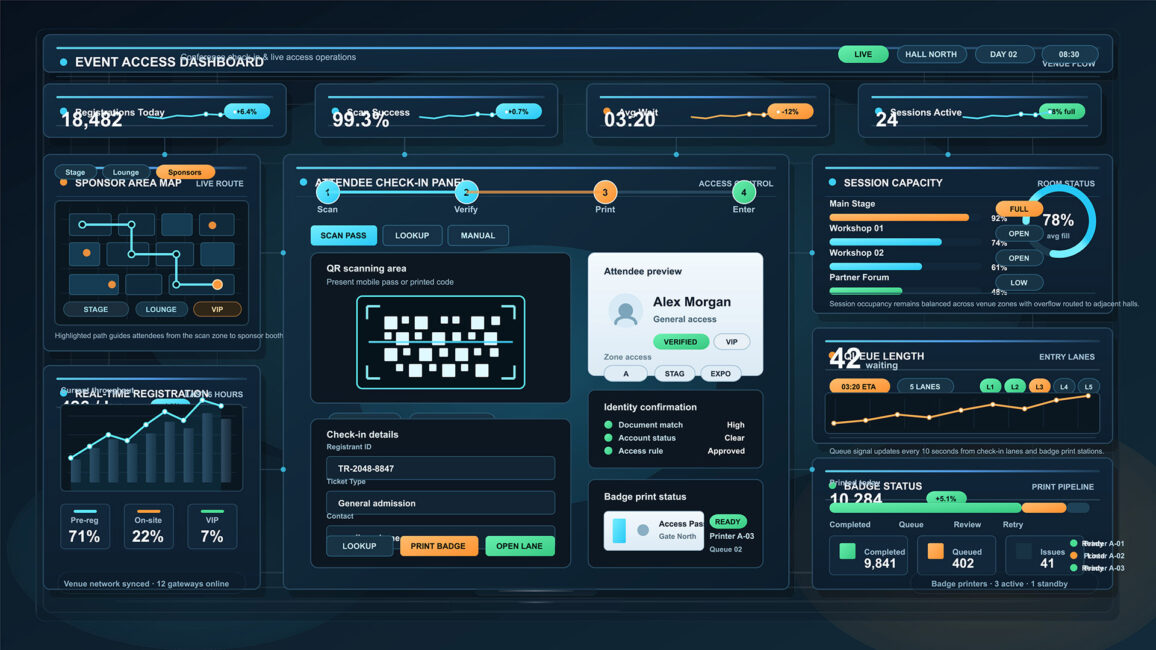
Modern event platforms treat registration, badge printing, and session tracking as connected systems rather than separate tasks. Registration platforms capture detailed attendee information upfront using customizable forms. Specialty, learning goals, session interests, etc., go beyond the basic name and email. Automated confirmations reduce no-shows. Real-time dashboards show who’s checked in and where capacity issues might emerge.
Instead of a pile of signatures, you capture structured participation data: when someone entered, when they left, and which sessions they attended. Skip the clipboards, bottlenecks, and illegible handwriting. For CME and medical education teams, the value isn’t in “engagement granularity” for its own sake. It’s in being able to show, with confidence, that each learner met the required time thresholds, completed the right components of the activity, and achieved the learning objectives you’ve defined. The same data that powers the badge scan becomes the backbone of your credit calculations, certificates, and audit trail.
THE VALUE SITS IN THE CONNECTIONS
Badge scanners that communicate with in-room AV or education platforms can do more than record who walked through the door. They can log entry and exit times, associate those timestamps with specific agenda segments, and tie responses from evaluation tools or audience-response systems back to an individual learner when appropriate. That means you can connect time-in-seat and assessment data in a way that stands up to internal and external review, not just count heads in a room.
Pharma and life sciences teams working under tight regulatory scrutiny need better compliance tools. Automated tracking delivers timestamped, auditable records. No longer relying on someone’s memory about whether Dr. Martinez signed in. Everything’s documented, exportable, and defensible.
Connect event data to your CRM or marketing automation platform, and the benefits multiply. Medical affairs teams see exactly which sessions a physician attended. Territory managers spot knowledge gaps worth addressing. Leadership asks for ROI, and you deliver data rather than guesswork.
Connect event data to your CRM or scientific engagement platform, and the benefits multiply—but only if the integration respects data governance, MLR, and HCP consent. Instead of a generic “push everything to CRM,” modern workflows map only appropriate fields (for example, attendance, credit claimed, and topic interests) into systems such as Veeva or medical information databases, following your approved rulesets. That lets medical affairs and field teams see which HCPs completed which activities, without creating a data-use headache for your compliance partners.
When those rules, consents, and field mappings are designed up front—and enforced consistently across vendors—you get a usable picture of education activity without risking a surprise at your next MLR review.
For CME and medical education teams, the value isn’t in “engagement granularity” for its own sake. It’s in being able to show, with confidence, that each learner met the required time thresholds, completed the right components of the activity, and achieved the learning objectives you’ve defined.
A CONCRETE WORKFLOW
To see how this works in practice, take a typical 60‑minute CME session: 45 minutes of faculty presentation plus 15 minutes of Q&A.
At registration, learners provide NPI and state license details, which are validated against your rules or a third-party service.
At the door, badge scans log the learner’s arrival time; a second scan on exit (or an automated read from RFID) records when they leave.
The CME platform calculates time in session; anyone who meets your threshold (for example, 45 out of 60 minutes) is automatically marked eligible for full credit, while those who fall short are either assigned partial credit according to your policy or flagged for manual review.
Evaluation forms and post-tests are tied to the same learner record, so you can confirm that both attendance and assessment requirements are met before credit is awarded.
Once the activity closes, the system generates certificates and emails them directly to learners, while creating a structured export that feeds ACCME PARS with the required activity- and learner-level detail.
From the planner’s perspective, the “work” shifts from hand-verifying sign-in sheets and building spreadsheets to configuring rules once—time thresholds, partial-credit logic, data fields, and PARS outputs—and letting the technology handle the repeatable tactics.
MAKING IT WORK ACROSS YOUR EVENT CALENDAR
For CME tracking, that consistency is more than cosmetic. Using the same check‑in method, time-calculation rules, and export formats across meetings means your year-end reports don’t require re-learning every vendor’s system. When your accreditation team asks for a complete view of participation by activity, therapy area, or audience, you can pull it from a single, standardized data set instead of reconciling dozens of one-off files.
Getting the administrative burden off your plate frees you to focus on strategy. Better learning design, stronger content, proof that events move the needle. Human management still matters. Technology just handles the tedious parts that used to eat up half your bandwidth.
Check-ins that generate structured, analyzable data instead of just names on a list build institutional knowledge. Every event gets sharper than the one before. Working with a technology partner that understands both event production and CME requirements helps you move from “chasing signatures outside the ballroom” to a repeatable, compliant model you can scale across the entire calendar.