What Is Lead Retrieval? A Guide to Capturing, Qualifying, and Converting Event Leads
7 minute read
Table of Contents
What Is Lead Retrieval?
WHAT IS LEAD RETRIEVAL?
HOW DOES LEAD RETRIEVAL WORK AT AN EVENT?
CAN VENDORS AND EXHIBITORS USE TRADE SHOW LEAD CAPTURE?
HOW CAN YOU USE LEAD RETRIEVAL TO INCREASE YOUR EVENT ROI?
WHAT FEATURES SHOULD YOU LOOK FOR IN LEAD RETRIEVAL SOFTWARE?
STILL HAVE QUESTIONS? CHECK OUT THESE LEAD RETRIEVAL SYSTEM FAQS
1. What devices can be used for lead retrieval at a conference or trade show?
2. Is it worth considering lead retrieval for a smaller event?
3. Can exhibitors qualify leads when scanning badges or other devices?
4. What’s the difference between barcode scanning and RFID lead retrieval?
What Is Lead Retrieval?
Lead retrieval is the process and practice of collecting critical information about the people who register for and attend your events. This gives you a more accurate snapshot of each person based on insights they supply, as well as insights derived from their event engagement actions.
Of course, to retrieve and interpret your event leads, you’ll want to put a lead retrieval system in place so it serves as an interconnected element of your event technology ecosystem. Ideally, this system will include the type of lead retrieval software you plan to use and how you will use the incoming data to drive your l
WHAT IS LEAD RETRIEVAL?
Lead retrieval is the process and practice of collecting critical information about the people who register for and attend your events. This gives you a more accurate snapshot of each person based on insights they supply, as well as insights derived from their event engagement actions.
Of course, to retrieve and interpret your event leads, you’ll want to put a lead retrieval system in place so it serves as an interconnected element of your event technology ecosystem. Ideally, this system will include the type of lead retrieval software you plan to use and how you will use the incoming data to drive your lead-related decisions before, during, and after the event.
If you plan thoughtfully, your solution of choice should become a sales enablement and ROI measurement tool that gives you a clearer picture of your event’s success.
HOW DOES LEAD RETRIEVAL WORK AT AN EVENT?
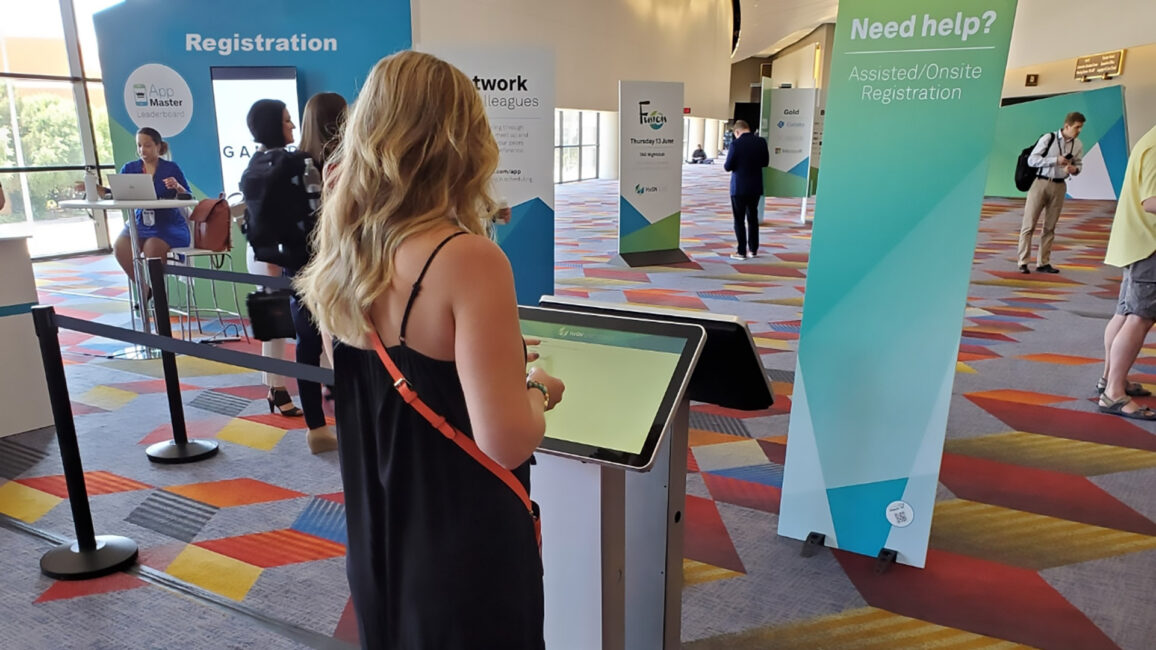
It’s easier to understand lead retrieval by considering an illustration of how it can work at an event. For example, let’s say that Rebecca is one of your event attendees.
As soon as Rebecca registers, her information will go into your lead retrieval software as a unique attendee. At that point, you can contact her through whatever means you requested (e.g., her physical address, her phone number, her email). Though you don’t have many insights about her, you have enough to consider her a future lead for your organization, your presenters, or your exhibitors.
When Rebecca attends your event, she then prints off an RFID-enabled badge. As long as you use advanced lead retrieval solutions like RFID gates and readers at your event, you can track where Rebecca goes in real time.
Now, the presentations, workshops, and vendors she visits are tracked and will give you a clearer picture of what interests her.
Now you have the information you need to send her a more personalized survey after the event that aligns with her custom itinerary. If you’re handing out certifications based on attendance, you can also verify that she attended the correct number of training sessions, since RFID badge information can be timestamped.
As you can see, lead retrieval matters greatly for trade show and conference planners. And with predictive AI technology, you can create detailed reports to inform the design and implementation of your future events.
CAN VENDORS AND EXHIBITORS USE TRADE SHOW LEAD CAPTURE?
Once your lead retrieval software is in place, you may want to share access with vendors and exhibitors as an added benefit of supporting your event. Many organizations that have booths and tables at events aren’t sure how to effectively capture the names and information of people who talk with their representatives. However, if your attendees have RFID-enabled badges, their badges can be used to show which booths they visited.
In other words, this reduces the reliance on business card collection for your vendors and exhibitors. Rather than having to manually input business cards (if attendees even have them), your vendors and exhibitors can simply scan people’s badges. It’s streamlined, efficient, and effective. (You may even be able to raise your vendor or exhibitor rates if you’re going to have a lead retrieval system at your event.)
HOW CAN YOU USE LEAD RETRIEVAL TO INCREASE YOUR EVENT ROI?
It can be challenging to gauge the ROI of your event without a conference lead retrieval system. But with a system, you can start to show the financial gains you’ve made by hosting an event.
What are some of the KPIs you could track using your lead retrieval process? Ticket sales, show rates, number of exhibit hall visits, and net promoter scores are just a few of the metrics you can gather from your software. The exact mix of KPIs will be based on the needs and expectations of your organization and planning team.
WHAT FEATURES SHOULD YOU LOOK FOR IN LEAD RETRIEVAL SOFTWARE?
There are many event lead retrieval software options on the market. That said, talk with your event technology partner about the software they suggest or use as one of their solutions. For instance, SmartSource helps event planners implement and optimize lead retrieval solutions, providing the technology, integrations, and onsite support needed to capture more meaningful attendee data and maximize event ROI.
User-friendliness is important. (If your team members find it too tough to tackle, you’ll miss the mark.) Integration with the systems you already use is also essential. You certainly don’t want to end up with siloed data in a format that can’t easily be shared across platforms.
Another mark of excellent lead retrieval software is its ability to run the reports you actually want. Otherwise, you’ll have to move your data into another software to get quick insights.
STILL HAVE QUESTIONS? CHECK OUT THESE LEAD RETRIEVAL SYSTEM FAQS
It’s understandable to have questions about lead retrieval opportunities, best practices, and solutions, even if you’ve been in the event planning space for years. Below are some of the questions our team regularly gets asked.
1. What devices can be used for lead retrieval at a conference or trade show?
RFID-enabled badges that print on demand can be used for lead retrieval. However, they’re only one type of device that can help you meet all your goals. Other devices include digital notepads and tablets, business card scanners, and smartphones.
2. Is it worth considering lead retrieval for a smaller event?
Yes! Even if you’re setting up a smaller event, you should use lead retrieval to document your attendees’ movements, collect feedback, and gain insights to help you scale.
3. Can exhibitors qualify leads when scanning badges or other devices?
They absolutely can — and do. Many exhibitors like the idea of gaining instant access to a booth visitor’s information so they can quickly determine if the attendee might be a strong lead. Again, this is where it helps if the lead retrieval software can link to another system the exhibitor uses, such as a sophisticated CRM platform.
4. What’s the difference between barcode scanning and RFID lead retrieval?
Event organizers and exhibitors often use barcode scanning or RFID technology to capture attendee information and measure engagement. Barcode scanning requires a badge to be scanned at a booth, session, or activation, while RFID technology can automatically track attendee interactions throughout an event.
As a result, RFID solutions typically provide deeper behavioral insights, such as session attendance and booth visits, while barcode scanning is often a more cost-effective option for basic lead capture. The right solution depends on your event goals, reporting requirements, budget, and attendee experience strategy.
You only have your attendees for a few days. But the data you can capture about them can endure if you design and follow a lead retrieval system. To have a conversation about the best solutions for your next large or small event, contact our team to set up a meeting.