How to Reduce Event Registration Lines Using Check-In Technology
8 minute read
Table of Contents
WHY EVENT REGISTRATION LINES FORM: THE MATH BEHIND BOTTLENECKS
HOW EVENT CHECK-IN TECHNOLOGY AND SELF-SERVICE KIOSKS STREAMLINE ATTENDEE EXPERIENCE
BENEFITS OF ON-DEMAND BADGE PRINTING VS. PRE-PRINTED EVENT BADGES
HOW TO DESIGN A HIGH-THROUGHPUT EVENT REGISTRATION FLOOR PLAN
EVENT NETWORK INFRASTRUCTURE: IMPLEMENTING OFFLINE MODE AND WIFI FAIL-SAFES
3 COMMON EVENT REGISTRATION INFRASTRUCTURE PITFALLS (AND HOW TO AVOID THEM)
FREQUENTLY ASKED QUESTIONS: EVENT CHECK-IN TECHNOLOGY AND LINE MANAGEMENT
1. What is event check-in technology?
2. How can I reduce registration lines at a conference?
3. Should I use self-service kiosks at our next event?
4. Is onsite badge printing better than pre-printed badges at an event?
5. How many check-in stations will I need for my event?
6. What happens if the internet goes down during my next event?
7. What is the fastest way to check attendees into an event?
KEY TAKEAWAYS: STREAMLINING EVENT CHECK-IN WITH AN INTEGRATED TECH ECOSYSTEM
The first physical touchpoint sets the tone for the entire attendee experience. But what happens if that initial impression is marred by a frustrating, disorganized conference check-in?
Unfortunately, that’s a common occurrence. From bottlenecks to misplaced (or misspelled) badges, plenty of logistics can go wrong for attendees at the beginning of an event. And attendees are likely to carry the bad taste of a disappointing check-in for their entire experience.
The upside is that you can avoid this problem with a strategic combination of expert planning and event check-in technology. To begin, though, you should understand the intricacies of event throughput.
WHY EVENT REGISTRATION LINES FORM: THE MATH BEHIND BOTTLENECKS
Simply put, throughput is the flow of event attendees as they walk into a venue and move through the conference check-in process. Ideally, you want to design a throughput arrangement that avoids long queues and gets people into the venue as fast as possible.
How can you minimize queues and keep wait times short? You can use some metrics.
For instance, let’s say you expect approximately 300 attendees to check into your event during the first hour. You will need to determine how best to keep them flowing into the main event spaces during the peak arrival window.
This means paying attention to your staffing needs. A traditional rule of thumb is that one staff member can check in an average of around 60 people per hour. Since you’re predicting that you’ll have 300 people, that means you need at least five dedicated registration table staff members.
What happens if some people take longer to check in than others? At this point, event registration lines can begin to cause disruptions and psychological friction. Research shows that people begin to feel irritated after standing in line for about 3 minutes. In fact, they often overestimate how long they waited, with most people exaggerating their wait times by as much as 36% later. This is why so many event planners are starting to embrace event registration technology solutions.
HOW EVENT CHECK-IN TECHNOLOGY AND SELF-SERVICE KIOSKS STREAMLINE ATTENDEE EXPERIENCE
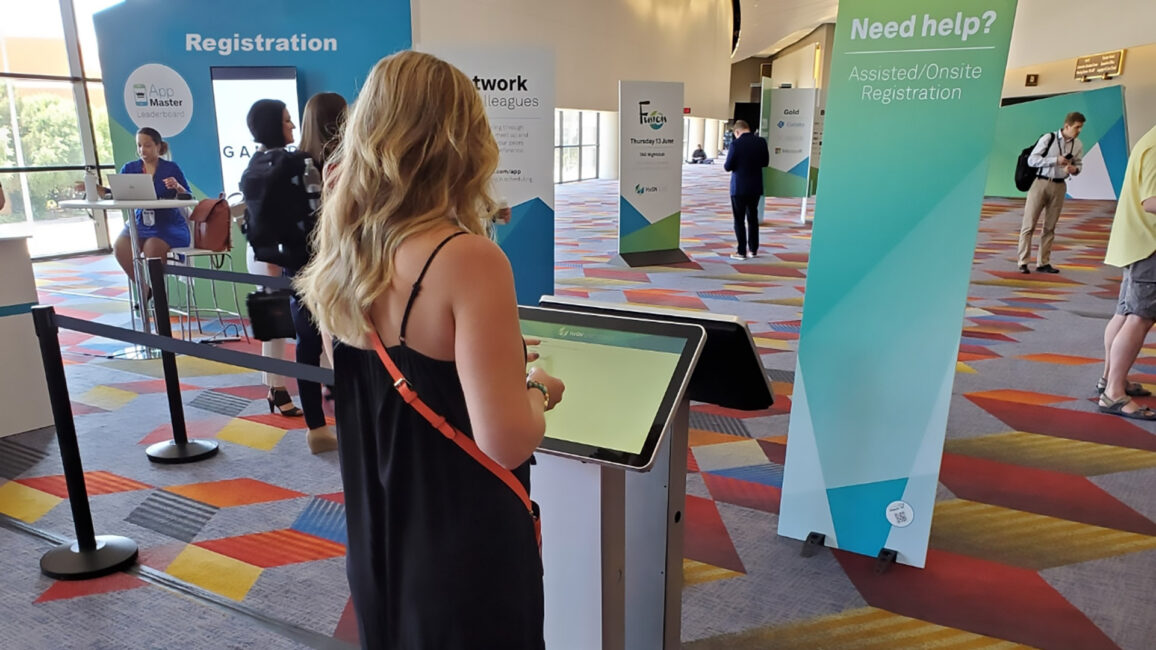
With event registration technology options like QR code scanning, mobile lookups, and self-service kiosks, event lines will always move much faster. Many self-service kiosk deployments can process roughly twice as many attendees per hour as traditional staffed check-in stations, depending on the registration workflow. You can still have a staffed help desk away from the main registration area. However, the more you allow check-in to be automated, the less of a throughput tangle you’re likely to have.
For example, imagine attendees walking to a self-serve kiosk and just scanning a QR code. Immediately, their registration will populate on the screen, allowing them to verify their data and make workshop and other event selections. Afterward, their badge can be printed on demand. At that point, they’re efficiently taking charge of their own check-in, which can effectively double the number of attendees who can check in each hour.
BENEFITS OF ON-DEMAND BADGE PRINTING VS. PRE-PRINTED EVENT BADGES
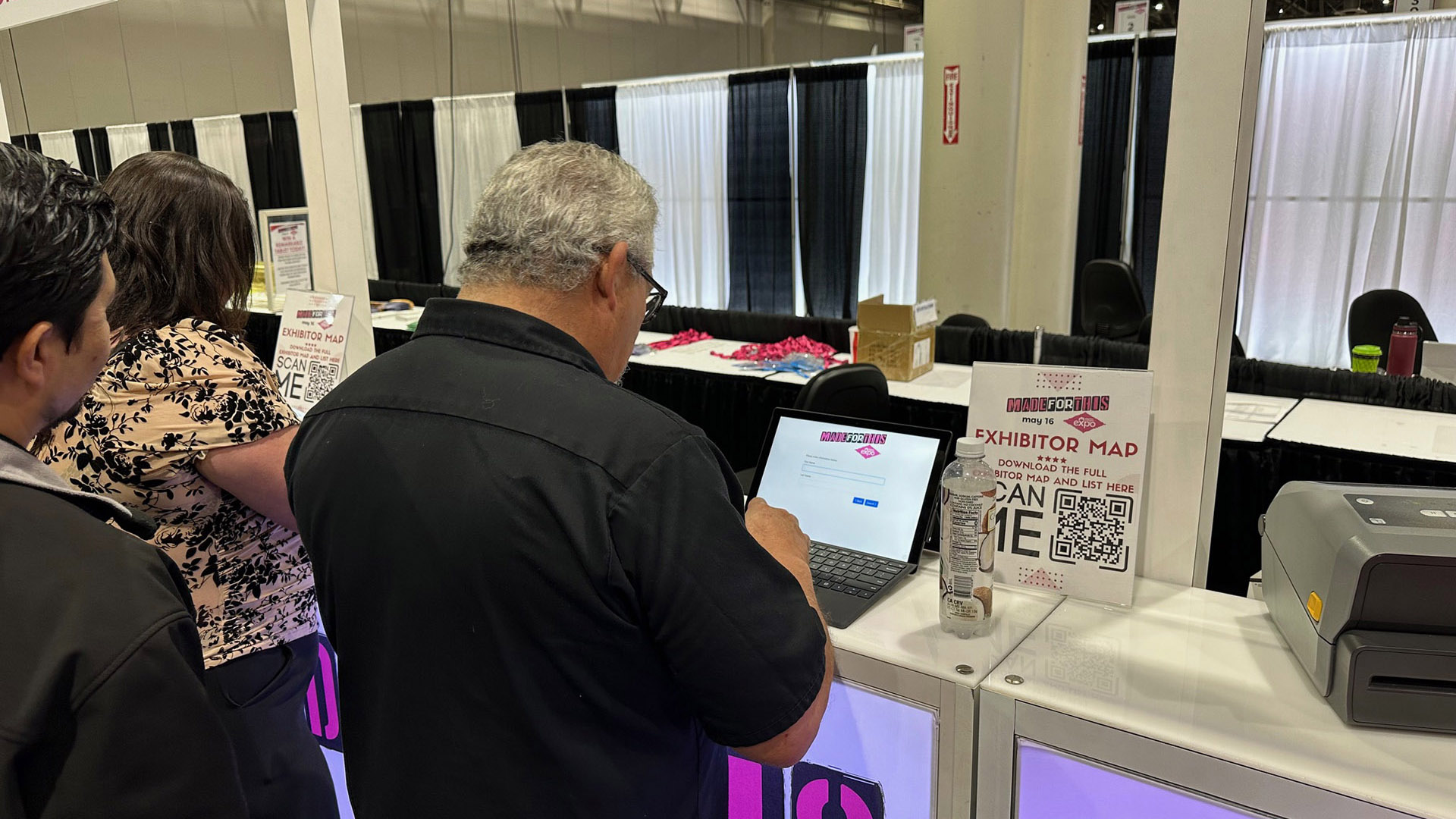
Self-serve kiosks offer more benefits than just allowing people to bypass lines. They also reduce the reliance on people to pre-print and sort badges, not to mention figure out how to print updated ones at the event. Who wants to alphabetize and organize (and check) hundreds or thousands of badges when self-serve kiosks attached to thermal printers can produce them as needed?
As a final note, offering high-tech badge registration kiosks shows your team is serious about reducing waste. Because badges are printed only when needed, organizers typically produce far fewer unused badges than with pre-printing. Plus, thermal badge printers eliminate the need for ink or toner cartridges. It’s a great win for everyone.
HOW TO DESIGN A HIGH-THROUGHPUT EVENT REGISTRATION FLOOR PLAN
Let’s say you’ve decided to move to a more technically sophisticated check-in process. At this point, you’ll need to work with an experienced event technology partner to design the physical registration process environment.
A solid rule of thumb is to create dedicated check-in lanes for different groups. For example, you may want to open separate registration lanes for your VIPs, your vendors, your speakers, media personnel, and general attendees.
By creating unique lanes, you can reduce choke points for all groups. And to handle all the last-minute registration glitches, you can have a standalone help desk that’s far enough away from all of your check-in lanes to avoid any congestion.
EVENT NETWORK INFRASTRUCTURE: IMPLEMENTING OFFLINE MODE AND WIFI FAIL-SAFES
As part of your high-throughput design, be sure to put measures in place to mitigate any connectivity issues. This means going beyond simply assuming that the venue’s WiFi system will be able to handle your online equipment and the connectivity needs of everyone in attendance at your event.
A resilient registration environment typically includes a dedicated local event network with offline synchronization capabilities. If internet connectivity is interrupted, registration devices continue operating against a local database and automatically synchronize attendee data once connectivity is restored.
3 COMMON EVENT REGISTRATION INFRASTRUCTURE PITFALLS (AND HOW TO AVOID THEM)
At this point, you probably have a good handle on maximizing your throughput during the first critical hours of your event. However, you should still keep three important factors in mind as you start to map out your event registration infrastructure.
First, be sure to add a dedicated lane for walk-up attendees. Alternatively, make certain they have an easy way to register and pay at your self-service kiosks. Otherwise, you could find it difficult to capture their data without causing line delays.
Second, if you have any pre-printed badges, such as for your speakers and special guests, check them multiple times to avoid errors. Misspelling someone’s name can leave a bad taste.
Finally, figure out how much WiFi bandwidth you’re going to need. You can use a calculator to help you determine exactly the right bandwidth for the size of your event.
FREQUENTLY ASKED QUESTIONS: EVENT CHECK-IN TECHNOLOGY AND LINE MANAGEMENT
Still have a few questions about increasing the throughput of your conference registration? These responses can help.
1. What is event check-in technology?
Event check-in technology encompasses multiple technical solutions (e.g., self-serve registration kiosks, on-demand printers) to improve throughput and reduce bottlenecks. When handled well, event check-in technology can improve the conference attendee experience.
2. How can I reduce registration lines at a conference?
Reducing registration lines at a conference or event involves designing a check-in process that suits the needs of all attendees, often using technology such as self-serve kiosks. Many event planners prefer to create different check-in lanes for different attendee populations (e.g., VIPs, special guests, vendors, pre-registered participants, walk-in participants) to minimize queues and wait times.
3. Should I use self-service kiosks at our next event?
If you want to reduce your reliance on staff members and improve throughput during your event check-in, you may want to consider self-service kiosks.
4. Is onsite badge printing better than pre-printed badges at an event?
Pre-printed badges may work well for smaller events with finalized attendee lists and minimal onsite registration changes. However, you can streamline the registration process, reduce waste, and improve the attendee experience by providing onsite badge printing (with or without self-service kiosks).
5. How many check-in stations will I need for my event?
In general, check-in kiosks can handle around 120 attendees per hour. Therefore, divide your peak arrival expectations by 120 to determine how many kiosks you may need.
6. What happens if the internet goes down during my next event?
If your event’s registration system is designed with offline capabilities, attendees can continue checking in even if the internet connection is temporarily interrupted. Once connectivity is restored, registration data automatically updates in the background.
7. What is the fastest way to check attendees into an event?
Because they can process registrations around twice as fast as human agents, self-serve kiosks are a much more efficient and speedy way to check attendees into an event.
KEY TAKEAWAYS: STREAMLINING EVENT CHECK-IN WITH AN INTEGRATED TECH ECOSYSTEM
Your check-in experience creates an attendee’s first impression of your event. Consequently, make sure you strategize how people will move through the registration process.
SmartSource’s registration technology doesn’t operate in isolation. Registration, onsite badge printing, mobile event apps, lead retrieval, and digital signage can work together as a single connected event technology ecosystem, reducing complexity for organizers while improving the attendee experience.
By investing in technological solutions and smarter infrastructure, you can wow your attendees from the moment they arrive. And you’ll be rewarded with higher net promoter scores, better feedback, improved event engagement, and increased attendee returns.